CNE: ‘Fiscal ’15 budget will not be structurally balanced’


Sergio M. Marxuach, the CNE’s director for public policy. (Credit: © Mauricio Pascual)
Contrary to what the government has been asserting over the past few months, the proposed budget for Fiscal 2015 will not be a balanced one because it is not factoring in sufficient appropriations to cover bond interest payments due, among other expenses, the Center for a New Economy said Wednesday.
“Next year’s budget is not balanced because the administration will use part of the bond issue put out in March to pay interest over those same bonds,” said Sergio Marxuach, public policy director of the independent think-tank during a roundtable discussion with members of the media.
Citing an official statement by the Gov. García-Padilla administration, Marxuach noted that there’s no guarantee that the Commonwealth will be able to make the needed adjustments in the General Fund to be able to pay interest on the bonds when they come due.
“A budget that relies on bond proceeds to partially pay for debt service as it comes due, is by definition, not a structurally balanced budget. Structurally balanced budgets generally feature recurring revenue sufficient to meet recurring expenses,” he said, citing a report released in March by Nuveen Asset Management.
“Therefore, by virtue of earmarking $269.8 million of bond proceeds for FY2015 debt service, Puerto Rico has already failed to deliver on its promise of a balanced budget in FY2015. A promise that, paradoxically, Puerto Rican officials were making while marketing the bonds to potential investors,” the firm said in the document Marxuach made reference to, to back his assertions.
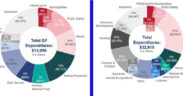
The García-Padilla administration is proposing a $28.1 billion consolidated budget and $9.6 billion General Fund budget for Fiscal 2015, which the CNE believes will be off by $578.8 million. The think-tank reached that number by adding $269.8 million in interest payments with borrowed money and $309 million in expense reductions the government is predicting, which it is unlikely to achieve.
Doubtful revenue-generating measures
Marxuach said the government is counting on a number of revenue-generating measures that may or may not materialize or generate the amount it is estimating.
In his presentation, Marxuach offered a rundown of 14 proposed measures the government is saying will shore up $540 million in revenue. However, the plan could fall short because of several uncertain elements, including counting on yet-to-be-approved bills to green-light the use of medical marihuana — which the administration believes could produce $5 million — and another bill regulating adult video lottery machines, to generate another $10 million for the government.
“This gives an idea of how desperate the government is, when they include bills that haven’t even been approved. They’re scraping the bottom of the barrel,” Marxuach said.
Meanwhile, he noted that the García-Padilla administration is proposing more than $1.3 billion in expense reductions, of which $309 million are considered “high-risk” and are most likely not to materialize.
“Every time the government says it’s going to carry out efficiencies, it usually falls short,” he said. “Based on the complexity of what they’re approving and the fact that they’ve fallen behind on implementing certain measures, such as collecting sales and use tax at the ports, which represented $170 million that they will unlikely get, my opinion is that they will not achieve such efficiencies next year.”