U.S. Census: 97K people emigrated from P.R. to the US in ’17

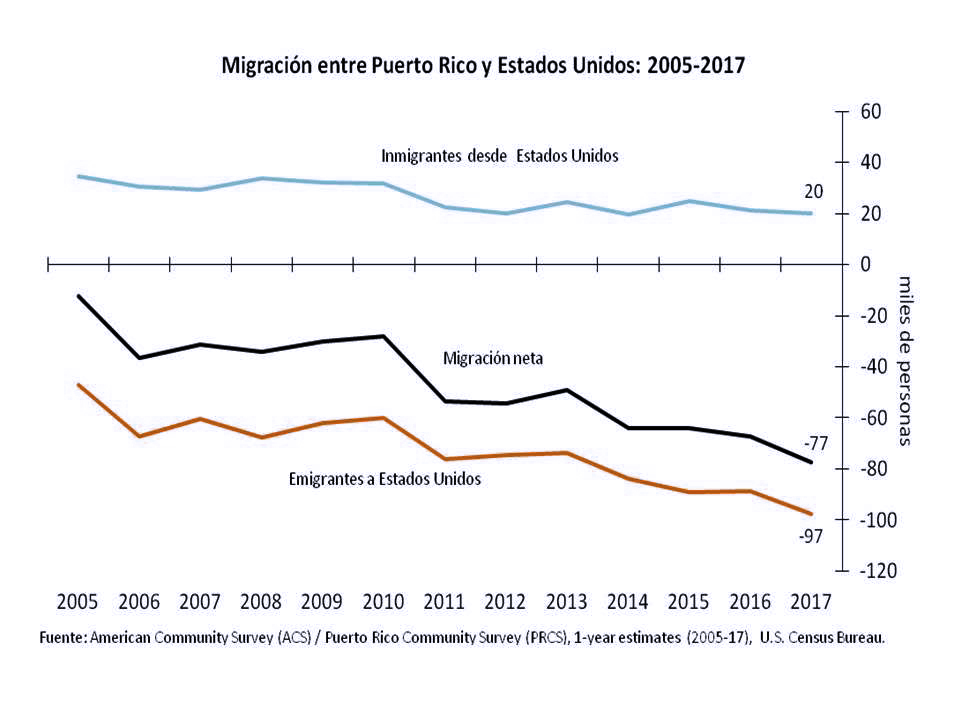
Some 97,000 people moved from Puerto Rico to the U.S. mainland in 2017, while 20,000 did the same, but in the opposite direction, resulting in a net migratory movement of negative 77,000, according to the U.S Census Bureau’s Puerto Rico Community Survey released Thursday.
The Survey’s statistics refer to the information collected during calendar year 2017 and includes social, economic and housing data for Puerto Rico and municipalities with a population of 65,000 people or more.
This is the highest migratory movement, both in absolute terms and in net terms, on record since the Puerto Rico Community Survey was launched in 2005, according to the findings revealed by the Puerto Rico Institute of Statistics, which belongs to the U.S. Census Bureau’s State Data Center network.
“These data will be described in more detail in the Institutes’ 2017 Migrant Profile, which will be published in the coming months,” the local agency noted.
The Survey also showed that median household income in Puerto Rico decreased by 3.7 percent between 2016 ($20,078) and 2017 ($19,343.) Household income categories showed that 60 percent of households had incomes of less than $25,000. Of these, nearly half (29 percent) had incomes of less than $10,000.
Furthermore, in 2017, 44 percent of people and 41 percent of families were below the poverty line in Puerto Rico. In families where women are heads of household with no husband present, the percentage was 59 percent, the survey showed.
Puerto Rico had a GINI index of 0.55, positioning itself as the jurisdiction of greater inequality in income distribution against other jurisdictions in the United States. The GINI index measures inequality, where a value of 0 is a perfect distribution of income, and a value of 1 is a completely uneven distribution.
“Although emigration goes back to breaking records again in 2017 in the Community Survey, this was expected after the passage of Hurricane María,” Institute Executive Director Mario Marazzi said.
“On the other hand, when analyzing these figures, it is important to recognize that the Community Survey is not designed to adequately capture the population displacement that can occur quickly and volatilely after a natural disaster,” he said.
“As a result, we note that these figures only include some of the people who moved after Hurricane María. Many others who could have moved temporarily or permanently are not captured in this survey, either because they moved to foreign countries, relocated to temporary housing where the questionnaire is not delivered, or are staying in homes of relatives who were living in the United States before 2017, among other possible reasons,” Marazzi said.
In that sense, it will be necessary to wait to see the results of the 2018 Survey to have a clearer picture of the post-María migration, he added.