Los expertos advierten a los legisladores sobre la definición propuesta para las zonas costeras.

Environmental groups and industry experts are calling for major revisions to House Bill 25, which seeks to redefine Puerto Rico’s maritime-terrestrial zone.
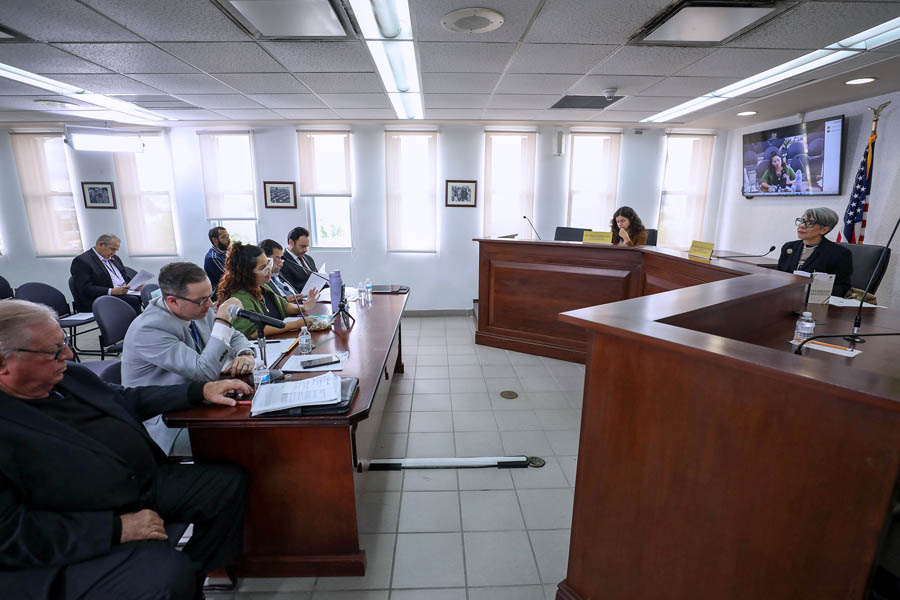
During a public hearing by the House Committee on Natural Resources, chaired by Rep. Elinette González-Aguayo, witnesses argued that the bill’s language fails to address climate change and coastal dynamics.
Representatives from the Puerto Rico Builders Association, the Engineers and Land Surveyors Association of Puerto Rico (CIAPR, in Spanish), and environmental group Amigxs del M.A.R. said defining the zone solely by astronomical tides is inadequate.
“This measure represents a step forward because it proposes using a tidal criterion to define the inland limit,” said attorney Patricio Martínez, environmental committee director for the Builders Association. “The problem is that it is a criterion not based on tidal data.”
Martínez explained that the bill uses equinoctial tides as a benchmark but ignores meteorological effects like tropical cyclones, making it hard to apply and enforce.
Builders Association President Agustín Rojo added that the definition “would create a boundary that would be impossible to mark physically throughout the year,” since it would only appear on specific days.
Both experts recommended adopting the Mean Higher High Water (MHHW) level, a standard used by U.S. federal agencies, as the defining measure.
CIAPR President Carlos Fournier also urged lawmakers to include sea level data and storm surge impacts, especially after hurricanes María, Irma and Fiona. He suggested waiting for the findings of the Joint Commission on Climate Change Mitigation, Adaptation and Resilience, expected in December 2026, before finalizing the definition.
Elga Vanessa-Uriarte, co-director of Amigxs del M.A.R., warned that narrowing the maritime-terrestrial zone limits public access to coastal areas. She called for a broader Coastal Law that integrates ecosystem elements and community input.
“If we need a definition that responds to our reality and climate crisis, it must emerge from a transdisciplinary approach guided by both community and scientific criteria,” Uriarte said.
González-Aguayo confirmed that the committee will continue collecting public and private feedback before drafting the final legislative report.
“Everyone agrees there are already environmental protection laws in place, but there are details that need to be defined, clarified and approached with awareness about how we use and protect our environment,” she said.