
Invasive lionfish presents biz opportunities for Puerto Rico restaurants, fishermen

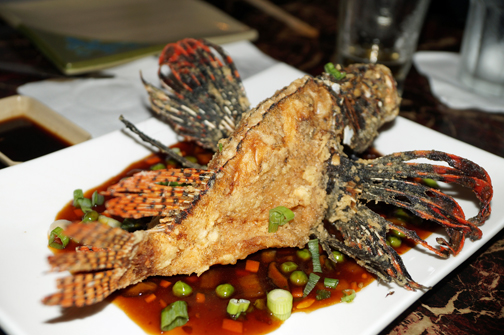
Sam Ng, proprietor of the Chop House Teppanyaki Grill and Sushi Bar recently showed the town of Dorado just how exciting lionfish can be to eat.
By Julian Bava
Especial para Noticias es mi negocio
In the past five years, Puerto Rico has experienced an unprecedented surge in its lionfish population. Previously unknown to Caribbean waters, the “pterois,” as it is known within the scientific community, has wreaked havoc on Puerto Rican coral reefs and, as a result, local fishing industry.
Because this new arrival has no natural predators to fear, it is free to satiate its voracious appetite at Puerto Rico’s expense, with seemingly no end in sight.
However, environment and business-consciousness entrepreneurs have recognized a way to not only combat the ecological threat posed by the lionfish, but also inject vitality into a suffering fishing industry.
Several island restaurants have begun serving fresh lionfish as either specials or even menu items. Supplied by local fishermen, restaurateurs have been able to attract customers curious about this exotic and delicious catch.
One such establishment is the Restaurante Vida Ventura, located in Adjuntas. After a welcoming tour of the Hacienda Luz de Luna, an entirely organic eight-course lunch was served featuring a masterfully prepared lionfish “en papillote.”
Chef Ventura Vivoni describes the fish as “very tender.”
The enterprising Sam Ng, proprietor of the Chop House Teppanyaki Grill and Sushi Bar recently showed the town of Dorado just how exciting lionfish can be to eat.
Ng was inspired to create a diverse array of dishes ranging from “crispy lionfish bites” to whole fish, steamed or deep-fried, served either in ginger scallion or black bean sauce.
Chefs and foodies alike may be concerned about the venomous spines situated at various points on the lionfish, and Ng warns, “Make sure you don’t get poked by that fish.”
Nevertheless, he effortlessly demonstrated how to remove the spines with a pair of heavy duty scissors.
Furthermore, Craig Lilyestrom, director of the Marine Resources Division at the Department of Natural and Environmental Resources, said, “Lionfish venom is only present in the spines of some of their fins — the pectoral fins and tail fin have no venomous spines — and once these spines are removed, the fish may safely be cooked and consumed as any other high quality marine fish.”
At approximately $5 per pound, the lionfish is not only an attractive catch for local fishermen but also an affordable opportunity for restaurants to expand their menu.
In short, a potentially devastating environmental and economic phenomenon could be reversed to the benefit of all.
Author Julian Bava is a senior at the TASIS School in Dorado. As part of his curriculum, he was responsible for conducting a community service project related to lionfish control and education, and he wrote this article as part of that effort. News is my Business is proud to support our high school students and welcomes editorial contributions of this nature for publication.


