
La PRMA expresa su oposición a la Ley 154; la CNE se pronuncia al respecto.

14 de enero de 2011
 |
|
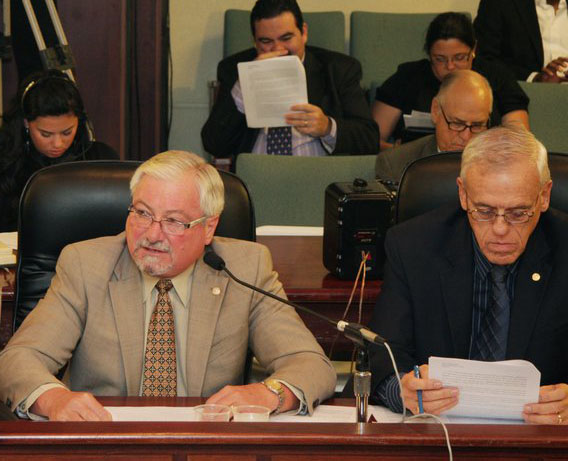
PRMA President Pedro Watlington and Executive Vice President William
Riefkohl
|
Casi 15 días después de que entrara en vigor la Ley 154, que impone un impuesto especial sobre las ventas de las filiales locales a sus empresas matrices extranjeras, los miembros de la Asociación de Fabricantes de Puerto Rico tuvieron la oportunidad el viernes de dejar constancia ante la Legislatura de su oposición a la medida.
During a hearing by the House Finance Committee, PRMA officials expressed their opposition to the clauses contained in the law that sets an initial 4 percent excise tax on transactions between offshore corporations and their local affiliates during the first year, and the manner in which it was approved.
The law was signed Oct. 25, 2010, just hours after it was rushed through the House and Senate, which approved it without public hearings.
Through the law, the government expects to collect about $6 billion over the next six years, when the temporary corporate tax will expire, to finance its tax reform plan. The trade group, however, supported the approval of the tax reform bill, as long as their recommendations are included.
During the hearing, PRMA President Pedro Watlington asked the heads of the House and Senate’s Finance Committees to immediately start a joint between the private sector and the government to try to amend errors contained in Law 154, before the start of the next legislative session.
“This law has created a very negative perception of Puerto Rico as an investment destination globally and it is a crisis that could be resolved, but we must begin a truly discuss and reach a consensus by working together,” Watlington said.
Among other things, the PRMA voiced its opposition to the changes to the income source rule, as it pertains to taxing revenue generated outside Puerto Rico.
“Adopting the proposed rule will leave Puerto Rico at a greater disadvantage than it already is to attract tourists andit would increase the cost of cargo shipping dramatically,” he said.
Furthermore, the group also rejected the increase to 10 percent from 7 percent on the retention for services offered within and outside Puerto Rico. The increase and the imposition of the 10 percent withholding on payments for services provided by affiliates outside Puerto Rico do not go hand in hand with the imposition of taxes on foreign companies following the source of income rules, they noted.
As a rule, in the case of foreign entities the income tax code collects from sources within Puerto Rico and income from services rendered outside of Puerto Rico is not considered income from sources within Puerto Rico. The PRMA suggested to leave the retention as outlined in the current tax code.
The group also said the proposed changes to calculating credits for purchases of local products will discourage such activity as well as export activity.
In its presentation, the PRMA said the amendments to the island’s Internal Revenue Code should attempt to minimize two long-standing problems: tax evasion and the ongoing reduction of the taxable base. Doing so will be achievable with simple mechanisms, Watlington said.
CNE analyzes proposal
Earlier this week, the Center for the New Economy analyzed the reform, saying it should follow four basic premises.
First, it should be sweeping, analyzing the entire system to avoid pitfalls associated with partial or incomplete reforms. Second, it should expand the taxable base by eliminating many credits and deductions granted over the years. Third, it should reduce marginal tax rates, as high tax rates provide a powerful incentive for people to alter their business and spend a considerable amount of resources a legally avoid paying impuestos. Finally, the reform should simplify the system.
“Puerto Rico’s Internal Revenue Code is complicated, unfair and terribly inefficient. These defects hamper management and supervision efforts, as well as complying with it, and in the long-run, these defects reduce the amount of revenue generated by the tax system,” said Sergio Marxuach, public policy director for the CNE.
Marxuach also weighed in on specific aspects of the proposed reform, such as provisions for individual and corporate tax rates and how tax relief will be financed.
“We believe that a new 4 percent excise tax on the sales of some companies operating in Puerto Rico to their affiliated companies outside of Puerto Rico is the main, but not only source, a fund tax cuts contained in the proposed reform,” he said.
Taxing further to stimulate economic growth is a method that has not been proven, and could conceivably work against any sought improvements.
Marxuach said the high level of uncertainty regarding how companies affected by the 4 percent tax will react — which includes reducing or closing operations — could lead to negative revenue growth and loss of jobs.
See related story: http://bit.ly/fJ7Iko and http://bit.ly/h2LuDm
Detalles del autor
Detalles del autor
Reportero de negocios con 30 años de experiencia escribiendo para periódicos semanales y diarios, así como para publicaciones especializadas en Puerto Rico. Entre mis antiguos empleadores se encuentran Caribbean Business, The San Juan Star y Puerto Rico Daily Sun, entre otros. Mis áreas de especialización incluyen las telecomunicaciones, la tecnología, el comercio minorista, la agricultura, el turismo, la banca y la mayoría de los demás segmentos de la economía de Puerto Rico.


