Public, private sectors wage battle against counterfeit medications


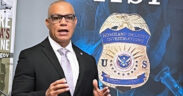
Pfizer executives Luis Samuel Abreu and Eladio Torres.
Things are not always what they seem, and in the case of counterfeit drugs, knowing the difference between what’s real and what isn’t could be a matter of life and death. With that in mind, pharmaceutical giant Pfizer launched an educational campaign this week to teach Puerto Rican consumers about the negative side of counterfeit medications, whose production and use is a growing global trend.
By definition, counterfeit medications are produced and sold with the intent to deceptively represent their origin, authenticity or effectiveness. While pharmaceutical companies lose hundreds of millions of dollars in yearly sales as a result of drug counterfeiting, the World Health Organization has said that counterfeit drugs make up 10 percent of the drug market worldwide.
Illegal drug producers will go to great lengths to copy as best as possible the pills used to treat chronic conditions, such as hypertension and diabetes. Counterfeit drugs are usually sold online or on the street, typically by unreliable or unauthorized sources. Counterfeit products have been found to contain toxic components such as brick and cement dust, boric acid and even paint residue.
“Counterfeit medications are fraudulent imitations. These medicines are deliberately and fraudulently labeled with respect to their identity or source. Their quality is unpredictable, as they may contain the incorrect amount of active ingredients, the wrong ingredients, or have no active ingredient,” said Eladio Torres, director, of Pfizer Global Security’s Americas Region. At present, Pfizer’s blockbuster drug Viagra, used to treat male erectile-dysfunction, is the most counterfeited drug in the world.
“Counterfeit drugs do not provide the expected therapeutic benefit. For example, a medicine used to lower cholesterol — or reduce the size of a cancerous tumor — may not provide the expected benefit because it is counterfeit,” said Luis Samuel Abreu, Director of Medical Affairs at Pfizer. “Another situation might be that the product exceeds normal limits of the active ingredient, which is also dangerous.”
Multi-sector anti-counterfeiting effort gains momentum
The U.S. Food and Drug Administration’s Office of Criminal Investigation has seen a consistent year-over-year increase in drug counterfeiting incidents, a problem that resulted in 72 probes in fiscal year 2010. While that number may sound low, the caseload represented an 11 percent increase from the prior year and marked the third consecutive annual hike in actions required to fight the negative trend.
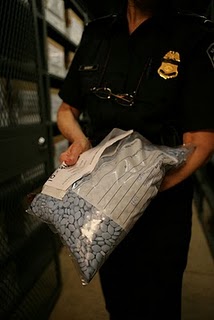
Confiscated bag of counterfeit Viagra. (Credit: Wikipedia Commons)
But the FDA is not alone in its efforts to tackle the dangerous and costly problem of drug counterfeiting. In December 2010, President Barack Obama pulled together a team of representatives from the Department of Homeland Security, the U.S. Department of Justice and the U.S. Immigration and Customs Enforcement to collaborate in anti-counterfeiting efforts.
While the U.S. market remains one of the safest, it is still vulnerable to clandestine imports from places such as China, India and Latin America countries where counterfeiting activity is high. In 2009, Customs seized more than $11 million in fake drugs, most of which came from China, according to industry reports.
The private sector is pitching in too, as pharmaceuticals and other business giants — Google, Microsoft, Yahoo!, MasterCard, Visa, American Express, and GoDaddy — are banding together to root out online pharmacies that sell fakes and educate consumers on the reasons why they should stay away from illegal medications.
Ongoing campaign
Pfizer has been working against the counterfeiting of medicines since 1998, through campaigns similar to the one launched in Puerto Rico, which focuses on the message that “when you buy prescription drugs on the street, you can not see the danger. There are pills that are almost identical. But they are not the same.”
Last month, the company’s anti-counterfeiting efforts were featured in a “60 Minutes” report that drew immediate praise from stateside nonprofit Partnership for Safe Medicines.
The global epidemic of fake medicines is a serious public health threat, and consumers’ lack of awareness of it only adds to the danger. Segments like the ‘60 Minutes’ piece are an important and welcome tool to help raise the issue among American consumers,” the group said.
Efforts to curb this epidemic have been ongoing for years, and over the past year we’ve seen an increased focus on counterfeit medicines among U.S. regulators, lawmakers, law enforcement and the medical industry,” said PSM, adding that it “applauds all of this, yet firmly believes that a sustained and coordinated global effort is required.”