
Business, consumer confidence dips in 2025 indices

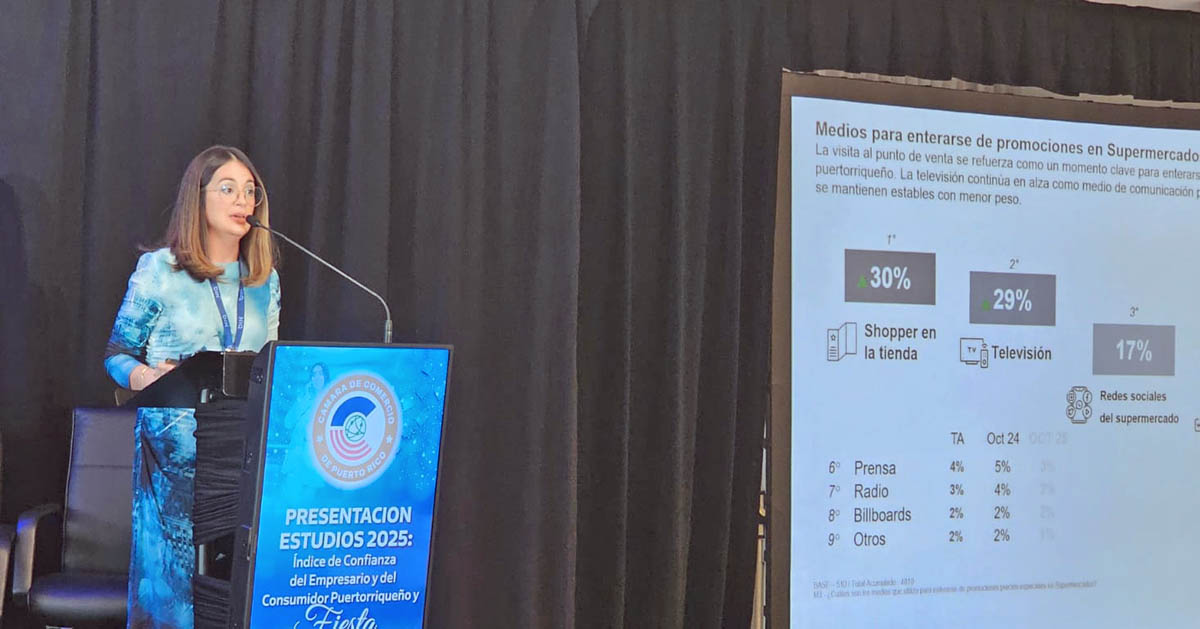
The Puerto Rico Chamber of Commerce released the 2025 Business Confidence Index and the Puerto Rican Consumer Confidence Index, reporting a cautious economic climate shaped by high operating costs, persistent inflation and widespread perceptions of recession.
The 2025 Business Confidence Index, based on responses from 216 participants, shows a moderate decline from last year and reflects a restrained outlook in the private sector. According to the report, 60.6% of respondents believe Puerto Rico is already in a recession, yet 63% still expect sales to increase over the next six months.
Expansion and hiring plans remain limited. Energy costs (45.8%), the tax burden (44.4%) and the general economic situation (42.6%) were cited as the top challenges for businesses, followed by bureaucracy and workforce shortages.
“The results reflect the pressures the private sector is facing, particularly in terms of operational costs,” said Chamber President Margaret Ramírez-Báez, adding that despite these constraints, “Puerto Rican entrepreneurs continue to demonstrate resilience and a willingness to keep investing and generating jobs.”
She called for stronger collaboration among the private sector, government and the legislature to “create a sustainable and competitive business environment.”
The report states that 84.1% of business owners believe product and service costs are still rising, with 36.6% attributing increases to tariffs. Nearly two-thirds of companies said tariffs have negatively affected operations.
According to the analysis, Puerto Rico’s economic recovery still depends heavily on nonrecurring federal funds, while gross national product projections anticipate contractions beginning in 2025.
The report also points to continued business transformation: 57.4% of companies use e-commerce tools and nearly half rely on alternative energy or water systems to maintain operational continuity.
On the consumer side, the 2025 Puerto Rican Consumer Confidence Index scored 91 points — four points lower than in 2024 but still above average, the Chamber reported. The results show a more cautious household outlook, particularly regarding economic stability.
The report indicates that 86% of consumers believe Puerto Rico is in a recession, and nearly four in 10 expect conditions to worsen within six months. Only 21% foresee improvement.
“Inflation continues to be the consumer’s main concern, followed by energy security, education and overall safety,” said Tatiana Irizarry-Hilera, sales leader for Consumer and Marketing Insights.
She said these pressures have made saving “a structural behavior,” noting that 79% of consumers have already changed their spending habits by reducing budgets for entertainment, home services and food purchases.
Despite tighter budgets, average monthly spending on food and household products reached $632 — the highest level since 2019 — with chain supermarkets remaining the preferred destination, according to the report. Digital shopping remains common, with 72% of consumers making at least one online purchase per month, though the survey found no increase from last year.
Both indices conclude that businesses and consumers are navigating a high-uncertainty environment shaped by inflation, recession concerns and limited confidence in future conditions. Even so, the findings point to continued adaptation as companies and households adjust spending and operational strategies.


