
González bets on Trump’s ‘energy dominance’ with natural gas

By Luis Valentín-Ortiz | Centro de Periodismo Investigativo
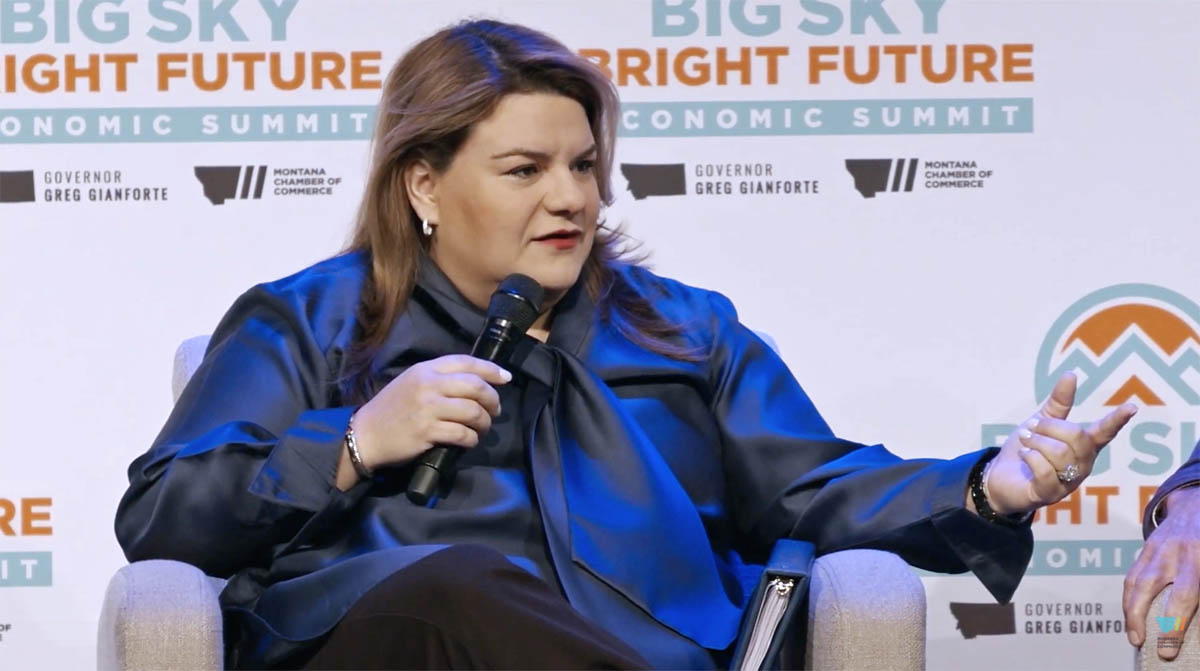
From an event hall in Bozeman, Montana, a small city in the American Midwest, Gov. Jenniffer González said in mid-October that “Puerto Rico should be the showcase of how American Energy Dominance can be [done].”
She was referring to President Donald Trump’s energy policy, which seeks to position the United States as the global leader in energy exports, driven by fossil fuels such as oil, coal, natural gas, and nuclear power, an option González had publicly dismissed just a month earlier.
Beyond the political alignment already visible between Trump and González Colón, some argue that Trump’s energy agenda for Puerto Rico should be even more expansive.
In an opinion column published in August, Justin Peterson, a Washington, D.C. lobbyist close to Trump and a former member of Puerto Rico’s Fiscal Control Board, proposed that the federal government take charge of privatizing and rebuilding Puerto Rico’s power system, anchored in natural gas and nuclear energy.
“The Presidential Council for Energy Dominance and the Department of Energy should lead this effort, working with a potentially reconstituted [Board],” Peterson wrote, after the White House removed five of the Board’s seven members in August.
The Centro de Periodismo Investigativo (CPI) asked La Fortaleza whether González Colón’s support for Trump’s energy agenda, as she stated in Montana, also extends to Peterson’s proposal.
“We respect Mr. Peterson’s opinion. He’s no longer part of the Board. He’s not an elected official. Obviously, as a colony, there are many people who like everything to be federalized,” said Jean Peña Payano, a legislative adviser to the Governor.
According to him, the González administration will pursue anything that helps achieve “energy relief and getting LUMA out.”
“If that includes [implementing Trump’s energy policy], we’ll gladly do it,” he added.
The CPI reached out, through a White House spokesperson, to the National Energy Dominance Council, a new executive office created by Trump to facilitate and accelerate projects aligned with this vision, but received no response.
Under the banner of “energy dominance,” Trump rolled back environmental regulations and sped up permit approvals for activities related to the extraction and export of fossil fuels, nonrenewable energy sources. In a recent proclamation declaring October 2025 as National Energy Dominance Month, Trump said that “three simple words” define America’s energy future: “Drill, baby, drill.”
Although “American Energy Dominance” has barely been discussed in Puerto Rico, the González administration has been implementing Trump’s energy agenda almost verbatim.
During her appearance at the Big Sky, Bright Future Economic Summit, a forum hosted by Montana Gov. Greg Gianforte, the Governor boasted that extending the life of the AES coal plant until 2032. The facility had been scheduled to shut down next year. She criticized the Biden administration’s strategy of prioritizing federal funds for renewable energy projects and pointed to the National Environmental Policy Act, or NEPA, as the main obstacle to lowering energy costs.
She also highlighted her first law in office, which eliminated the intermediate benchmarks established years ago requiring Puerto Rico to reach 100% renewable energy by 2050.
But if anything was unmistakable during her participation, it was her embrace of U.S.-sourced liquefied natural gas (LNG) as Puerto Rico’s primary energy source.
“I believe in American LNG,” González said repeatedly while discussing the $4 billion contract she signed with New Fortress Energy (NFE) to supply natural gas for seven years, a deal that had, until then, been rejected by the Fiscal Control Board.
On Friday, Nov. 28, the Board announced it had approved the NFE contract, but warned that even with the revisions made to the agreement, the company would retain a monopoly over the supply of that fuel at the Port of San Juan.
“This lack of competition affects the reliability of the energy system, prices, and Puerto Rico’s overall economic competitiveness,” the Board said.
Puerto Rico bets on gas again
This is not the first time Puerto Rico has pinned its hopes on natural gas. Over the past 20 years, governors from both major political parties have promoted the use of this fossil fuel under the premise that it would lower energy costs on the island.
Under former Gov. Aníbal Acevedo Vilá, construction began on the ill-fated “southern gas pipeline,” intended to transport gas from Peñuelas to Salinas. Then came Gov. Luis Fortuño, who also failed in his attempt to build the “northern gas pipeline,” known as Vía Verde, designed to move gas from the island’s south to its north. In the 2014 energy reform signed by Gov. Alejandro García Padilla, natural gas was framed as a “transition” fuel on the way toward renewable energy.
During the Ricardo Rosselló administration, two years after the cancellation of the Aguirre Offshore GasPort project in 2017, NFE arrived as the main gas supplier and to build a new receiving terminal. Its inauguration was celebrated in 2020 by then-Gov. Wanda Vázquez. And in his final week in office, Pedro Pierluisi laid the foundation stone for the new gas-fired plant now under construction in San Juan by the Energiza consortium.
But the Governor’s plans for natural gas, including the new contract with NFE, tie Puerto Rico’s energy future to this fossil fuel, placing the island’s goal of reaching 100% renewable energy by 2050 at risk.
In addition, the generation projects announced by her administration would result in an energy surplus in Puerto Rico, according to the Institute for Energy Economics and Financial Analysis (IEEFA), and would drive up electricity costs.
Of the 1,200 megawatts the Governor claims to have added to the grid in the past 10 months “just by fixing old plants,” nearly half relies on natural gas. And although the Energiza plant was initiated under former Gov. Pedro Pierluisi, González has continued its construction; it would add 450 megawatts powered by liquefied natural gas. Fourteen emergency generators left behind by FEMA also run on this fossil fuel. Meanwhile, the private operator Genera PR, which manages the former Puerto Rico Electric Power Authority generation fleet, is pursuing projects to convert most of those plants to natural gas.
This administration also approved three new generation projects in October that would collectively add 800 megawatts, primarily through diesel. That same month, the Government released a new request for proposals for up to 3,000 megawatts of additional generation.
“If these plans materialize, Puerto Rico will have far more capacity than it needs, and this problem will only worsen in the future as residents and businesses continue adopting rooftop solar with battery storage,” said Cathy Kunkel, an Institute for Energy Economics and Financial Analysis (IEEFA) consultant.
Those who remain connected to the centralized power system would face higher electricity costs because of these inefficiencies.
To supply nearly 100% of the natural gas the island needs, the González administration selected NFE, the parent company of Genera PR.
“What I did over the summer is that I renegotiated a deal to bring more LNG to the island, because we need to move forward from petroleum, and I cut from $20 billion to $4 billion a contract of LNG for the island and I’ve been waiting since June to get it approved by this federal board. […] I believe in American LNG,” González said in Montana.
The Governor was referring to the Fiscal Control Board. However, she did not clarify that her administration had tried unsuccessfully to execute the same contract, at 15 years and $20 billion. At the time, the Board rejected the agreement, noting that it would establish a monopoly over fuel supply, among other concerns.
In September, a renegotiated version of the contract was announced, this time for seven years and $4 billion. Although González claimed her administration removed a clause preventing another supplier from entering the market if NFE failed to meet its obligations, the Board raised new objections in October regarding the contract’s language.
Late Friday night, the Fiscal Control Board announced its conditional approval of the contract, requiring revisions to a separate agreement between NFE and the Government that governs the entry of other gas suppliers into the Port of San Juan if NFE is unable to do so.
Regarding this deal, IEEFA warned that, in addition to the possibility that Puerto Rico may end up buying more gas than it needs, the Government would remain tied to a company facing serious financial troubles.
As the CPI revealed in 2022, NFE has repeatedly failed to deliver natural gas as agreed, forcing the Government to purchase diesel, a more expensive fuel whose cost is passed directly to customers through higher electricity bills.
As part of its approval of the NFE contract, the Board required the Government to prepare “an evaluation of the amounts that should be returned to the people of Puerto Rico to compensate for diesel expenses incurred as a result of NFE’s delivery failures under existing contracts.”
This report must be submitted no later than March of next year.
Energy Dominance Council
Trump created the National Energy Dominance Council in February through an executive order. The Council is led by Interior Secretary Doug Burgum and Energy Secretary Chris Wright, and its mission is to fast-track projects that “help America at home, help us sell energy overseas,” explained Executive Director Jarrod Agen in an interview.
Agen, who also advises Burgum and previously served as communications director for Vice President Mike Pence, said the Council works with the oil, gas, and mining sectors to advance projects that, in his view, have been stuck in permitting processes for years.
“We’ve been very effective — because we didn’t bring in a bunch of academics. We took people directly from industry in particular areas — oil and gas, coal, mining, and nuclear. And so, we have a very small team. It’s a start-up within the White House,” Agen said in September.
Trump also canceled renewable energy programs funded with federal dollars, some of which were intended for solar and battery projects in Puerto Rico, eliminated restrictions on oil burning, and opened the Arctic National Wildlife Refuge in Alaska to fossil fuel exploration.
The measures taken by Trump have largely benefited the oil and gas industry, which financially supported his 2024 presidential campaign. One of the key figures behind shaping Trump’s energy agenda was Burgum, who pledged at campaign events that the president would halt “the hostile attack on American energy,” The Washington Post reported.
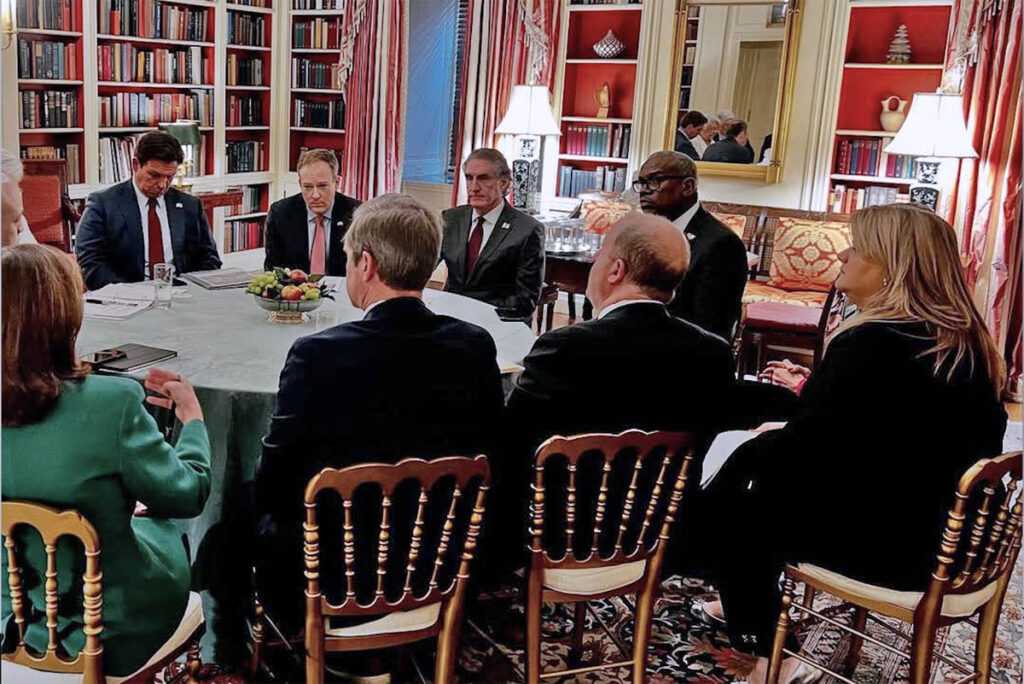
As early as February, González posted a photo of a meeting with Burgum at the White House, where they discussed “energy and permitting matters for Puerto Rico,” according to her social media post.
Meanwhile, the González administration has hired at least three lobbying firms for $1.5 million to position itself in federal discussions on Capitol Hill and at the White House about energy policy.
One of these firms is Navigators Global, through which the Puerto Rico Government has monitored the implementation of Trump’s energy agenda, according to invoices obtained by the CPI through a public records request.
In March, for example, Navigators’ lobbyists reported that they “flagged comments by Secretary of Energy Wright regarding Puerto Rico’s energy system, identifying opportunities for strategic follow-up,” while in April they closely tracked congressional discussions about vulnerabilities in the U.S. electrical grid with the goal of “elevating the urgency of modernizing Puerto Rico’s energy infrastructure.”
The invoices also describe coordinated meetings with members of Congress and White House officials. Among the lawmakers most frequently mentioned is Republican Sen. Mike Lee of Utah, who chairs the Senate Committee on Energy and Natural Resources.
Senator Lee is not a newcomer to Puerto Rico’s energy affairs. In 2019, the CPI revealed emails showing that before the Government announced its intention to privatize the Puerto Rico Electric Power Authority that same year, and before LUMA Energy arrived in 2021, Lee had quietly promoted, through communications with the Fiscal Control Board, a proposal to privatize the public corporation through federal legislation.
At least since last March, the González administration’s lobbyists have sought to establish a direct line to Lee’s office.
The March invoice submitted by Navigators notes that the firm coordinated with Spencer Stokes, a Utah lobbyist who served as Lee’s chief of staff more than 12 years ago, “to ensure continued follow-up and scheduling of a meeting between Chairman Lee and Governor Gonzalez.”
In April, Navigators reported coordinating a meeting between Puerto Rico’s Federal Affairs Administration and a staff member in Lee’s office “who agreed to assess the possibility of a congressional delegation visit to Puerto Rico focused on energy resiliency.” The lobbyists then followed up “to confirm interest in scheduling a direct meeting with Governor González-Colón and to coordinate staff-level engagement on upcoming territorial hearings.”
Another meeting arranged by Navigators on energy issues involved Wendy Baig, the director of the Senate Energy and Natural Resources Committee and an adviser to Sen. Lee, to “explore legislative avenues related to Puerto Rico’s energy resiliency and infrastructure modernization.”
Governor’s double message on renewable energy
During her appearance in Montana, González said the Biden administration used Puerto Rico, and the nearly $18 billion in federal funds she claims to have secured for the electric grid while she was Resident Commissioner, as a “laboratory” for renewable energy.
She noted that she is still waiting for the delivery of storage batteries that the Government purchased from Tesla for $750 million, suggesting that they are not a short-term solution. She also said her administration used $365 million in federal funds allocated to a solar energy program to carry out repairs at power plants that would add 400 megawatts of capacity.
“In the last four years, it was Washington dictating what the island needs. And what happened [is] they decided to have Puerto Rico as a laboratory for renewable, solar panels, batteries. And I don’t have anything against that. But you cannot run an island, businesses, manufacturing and hospitals, 24/7 with batteries,” González said.

However, Puerto Rico is home to manufacturers such as Eaton and Medtronic and pharmaceutical companies like Pfizer and Eli Lilly, whose plants are partially powered by solar and battery systems, according to data from the U.S. Energy Information Administration.
Two weeks later, at the Solar and Energy Storage Association (SESA) conference in San Juan, the Governor struck a different tone when talking about renewable energy.
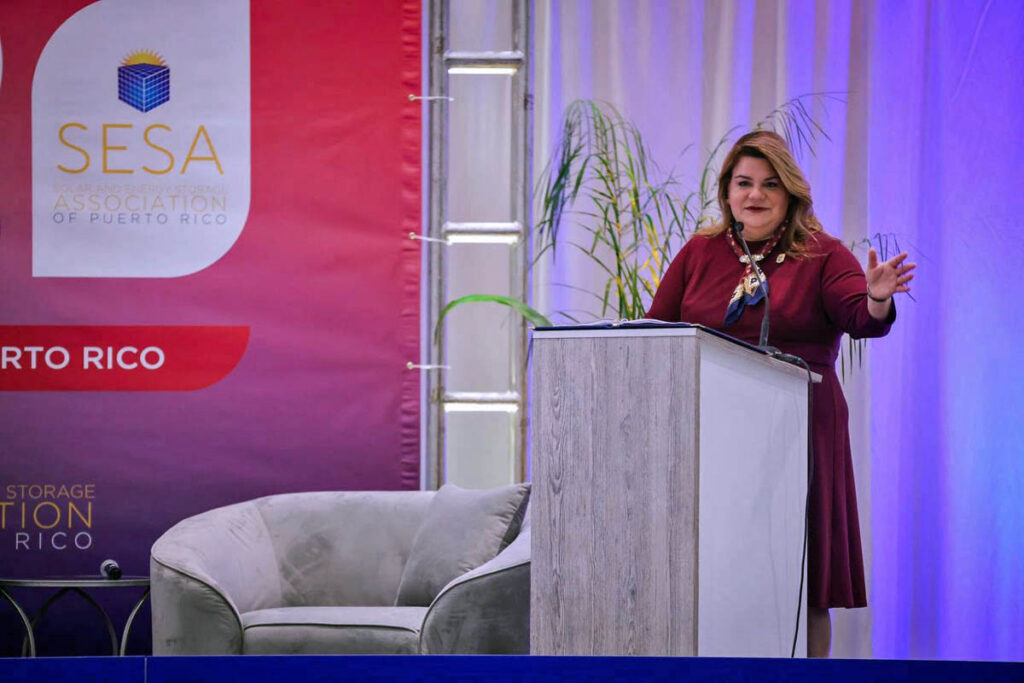
“From the Tesla Megapack battery project to the accelerated approval of renewable energy under Executive Order 2025-047, we are working hand in hand with organizations like SESA to achieve our shared goal of delivering real progress for our people with a new grid operator,” read the statement La Fortaleza sent to the press.
The Governor’s shifting rhetoric on energy may reflect the Trump administration’s softened stance toward renewables, according to former Popular Democratic Party Sen. Eduardo Bhatia, now a public policy professor at Princeton University, who led the 2014 energy reform as Senate president.
“The biggest challenge the Governor has faced is trying to decipher Trump’s Department of Energy,” Bhatia told the CPI.
“I think the Governor has been very careful not to cross a line,” he added.
Beyond González Colón’s statements about American energy dominance and the solar industry, her administration’s actions point in a clear direction: liquefied natural gas.
Even before taking office, González appointed Josué Colón as her “Energy Czar,” a new role with authority to oversee, coordinate, and monitor the reconstruction and modernization of the electric system, according to the announcement of his appointment. Colón began steering the system toward natural gas nearly 15 years ago, when he served as generation director at the Puerto Rico Electric Power Authority during the Luis Fortuño administration. In 2021, he returned as the public corporation’s executive director, and under his leadership, PREPA handed over the operation of most of its generation fleet to Genera in 2023.
Like the Governor, the so-called Energy Czar believes natural gas should be Puerto Rico’s primary power source. Colón has argued that solar energy is not “cost-efficient” for most residents and that, to carry out González Colón’s public policy of making U.S. natural gas the island’s main energy source, Puerto Rico would need to build gas pipelines, which he describes as the “most efficient, safest, and most cost-effective” way to transport the fuel.
“And the public needs to understand that,” he said in June during a luncheon hosted by the United Retailers Association (CUD, in Spanish).
Hours later, at a press conference where the Energy Czar was also present, the Governor denied that her administration had any plans to build gas pipelines.
For Bhatia, the issue represents “a major political problem,” considering that Puerto Rico has no political or social appetite for such projects.
The first bill González submitted to the Legislature as governor — and the first to become law — eliminated the intermediate benchmarks established under Energy Public Policy Law Act 14, which mandates that 100% of Puerto Rico’s energy come from renewable sources by or before 2050. According to her, this action opened the door to using liquefied natural gas as a “transition” fuel, even though LNG had already been part of the island’s energy policy since 2014.
“What she did amend [from the energy reform] was the use of coal. That was supposed to end by 2027, and she pushed it [to 2032],” Bhatia said, referring to the AES coal plant.
When the Montana event opened to audience questions, there was only one, from a man who said he had friends in Puerto Rico “because it’s a tax haven,” who asked: “Why doesn’t Puerto Rico build a port for natural gas traffic? Has it considered that?”
“Of course. And that’s what we all want. And we’re on the same page. I was criticized during the campaign because I was the only one calling about using American LNG. How are we the main [LNG] provider for many countries and we cannot do that in our territory?” the Governor replied, referring to the possibility of increasing Puerto Rico’s consumption of U.S.-produced liquefied natural gas.
“I’m looking for two things: switching from 62% petroleum to LNG. And the second one is literally changing the operator of the transmission system [LUMA],” she said.


