Puerto Rico emerges as 5G standout in uneven LatAm rollout

Puerto Rico ranks among the most advanced 5G markets in Latin America, even as progress across the region remains uneven, according to a new analysis by network intelligence firm Ookla.
More than five years after 5G technology began rolling out in Latin America, the service is now available in many countries, but adoption levels and network performance vary widely. Puerto Rico stands out for its early and extensive deployment of 5G Standalone technology, a more advanced version of the network that operates independently from legacy infrastructure.
In the third quarter of 2025, 41.1% of all 5G connections in Puerto Rico used 5G Standalone architecture, the highest share in Latin America, according to the report.
Ookla attributed the island’s performance in part to network strategies aligned with the U.S. market, noting that Puerto Rico’s position is “likely thanks to T-Mobile’s network” on the island, as the carrier moved early to deploy 5G Standalone technology across its U.S. operations.
Puerto Rico also ranked near the top of the region in 5G availability, a measure of the percentage of time users are connected to a 5G network. The island placed just behind Uruguay and ahead of Brazil, indicating that a large share of users spend most of their mobile time on 5G connections.
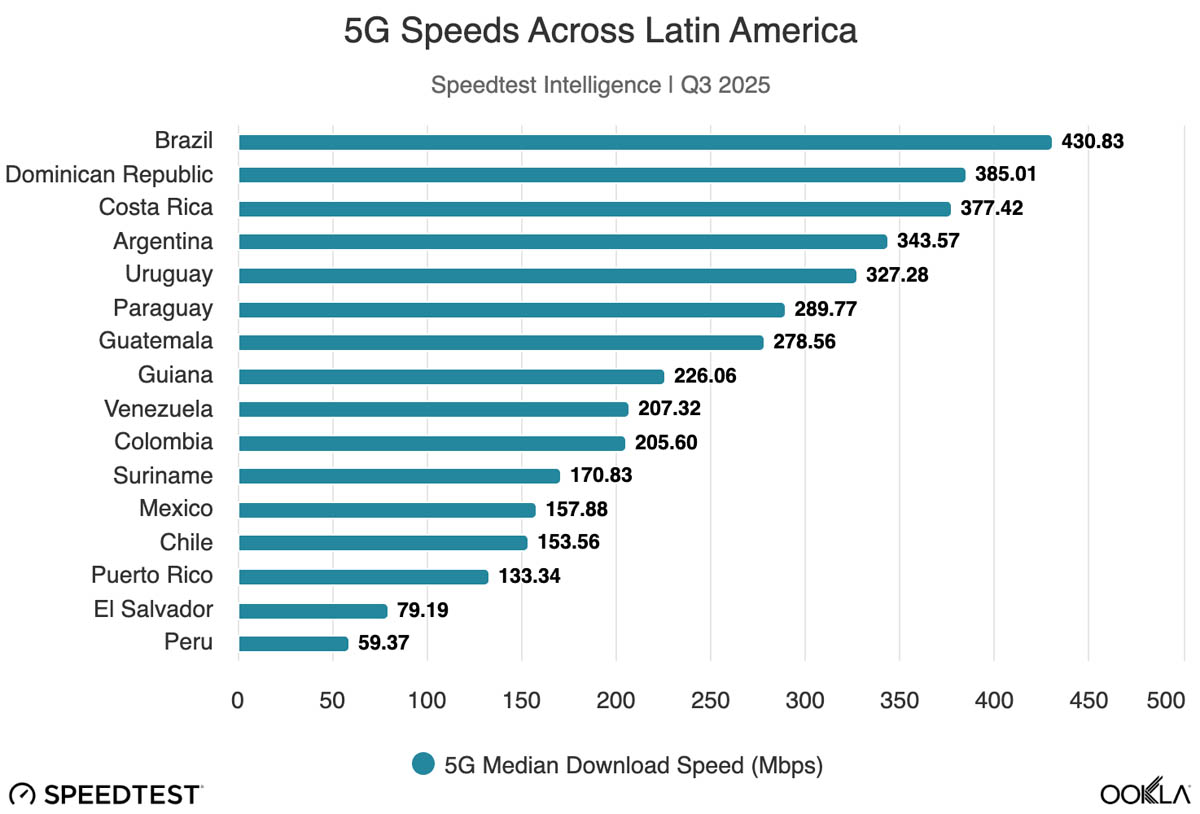
Brazil, however, leads Latin America in raw 5G speed performance. Median 5G download speeds there reached 430.83 megabits per second (Mbps) in the third quarter of 2025, the highest in the region.
Ookla attributed those speeds to large allocations of midband spectrum in the 3.5 gigahertz range, noting that operators with access to 100 megahertz of spectrum in that band typically deliver speeds exceeding 300 Mbps.
Despite pockets of strong performance, the report found that 5G deployment across Latin America remains uneven. In Mexico, rollout efforts have advanced at different paces among operators, while in countries such as Peru, 5G development remains at an early stage.
The analysis also points to signs of broader technological maturation. Fixed wireless access services are expanding, allowing operators to offer broadband alternatives to homes and businesses, while private 5G networks are beginning to emerge to support industrial and enterprise applications.
The report emphasizes that spectrum availability is a decisive factor in 5G performance. Countries that released large, contiguous blocks of midband spectrum earlier have seen stronger performance and adoption. Although the average amount of spectrum assigned to mobile operators in Latin America has increased significantly since 2016, Ookla noted that it still remains below the global average.