BioLeap guides Puerto Rico scientists into entrepreneurship

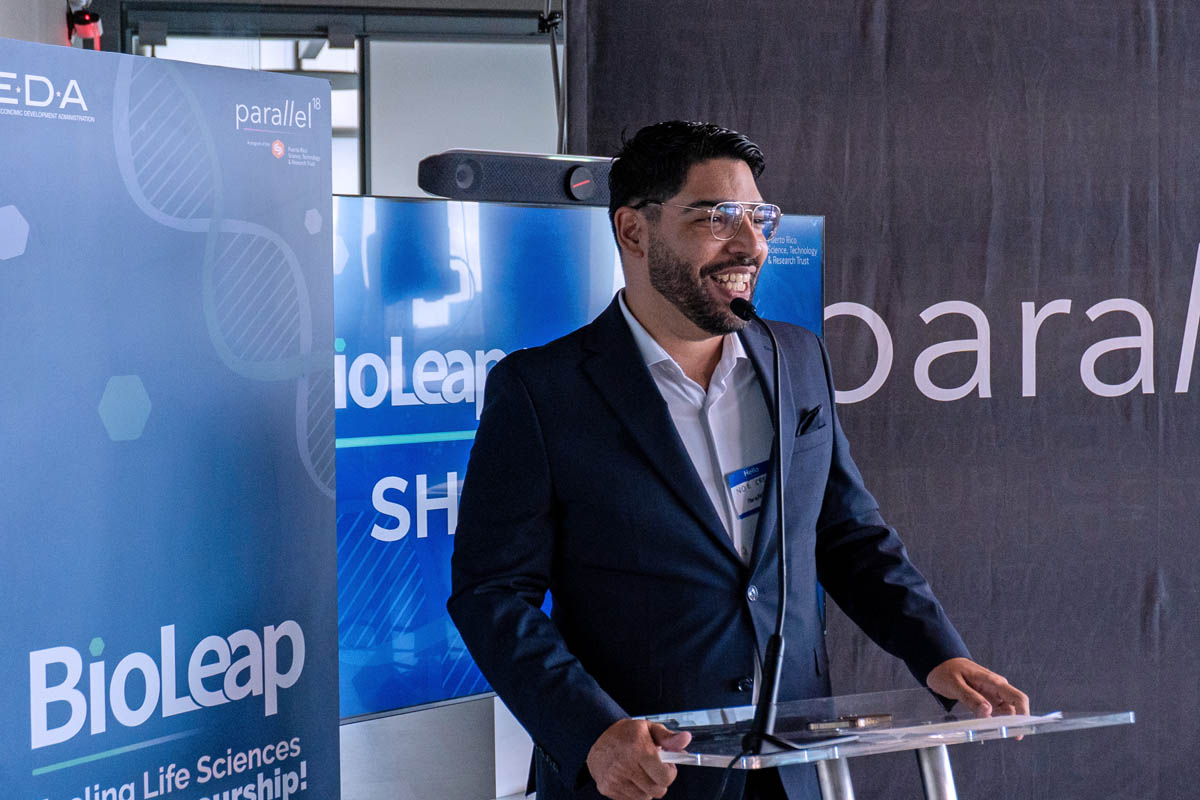
Local scientists need a mindset adjustment as well as education and training to commercialize their scientific ideas, research and development into business solutions, Noe Crespo, director of Parallel 18’s BioLeap incubation program, whose application period for Cohort 3 in February closes Dec. 12, told News is my Business.
“Commercialization in life sciences is difficult because scientists are trained to have questions, develop hypotheses, come up with solutions and publish their work. Moving to the business side requires a leap of faith because we don’t normally think of our science as a product or service, so the scientist mindset must change to commercialize a project,” Crespo said.
Scientists also need to consider complex regulations, additional tests and clinical trials when exploring the possibility of commercializing their science, a long process that delays taking a product or service to market.
“A fintech startup can be in the market within a year or two, but a life science startup can take seven to 10 years,” he said. “There’s a lot of sacrifice. You have to prioritize the project’s development over revenue, profit and salary.”
For example, Ihnnova, a bioscience startup that participated in BioLeap’s Cohort 2 this year, could take 20 years to go to market, but BioLeap’s mentors, networking, funding opportunities and investment resources can shorten the time it takes to commercialize a science project into a product or service, Crespo explained.
Ihnnova has one and a half more years of preclinical studies, said founder Jorge Castro, who holds a doctorate in bioengineering from the University of Puerto Rico, Mayagüez. The company is working on commercializing a treatment for lower-to-intermediate-risk prostate cancer patients.
Idhaliz Flores is another Cohort 2 alumnus. She is co-founder and co-owner of Sur180 Therapeutics, an R&D startup that focuses on developing new therapies for endometriosis, and chief scientific officer for Nura Health, which develops noninvasive diagnostics and precision medicine for endometriosis and other women’s health conditions.
A molecular biologist who has been researching women’s health issues for more than 25 years, Flores was frustrated with the limitations of R&D. “We made scientific discoveries, but at the end of the day, the patients stayed the same, without treatments that worked for them,” she told News is my Business.
“The purpose of research is to find facts we can publish, but once we publish them, they have no commercial value because companies won’t develop these findings when there’s no profit in it,” she said.
After completing a doctorate in microbiology and genetics from Rutgers University in New Jersey, Flores returned to Puerto Rico and joined the faculty at Ponce Health Sciences University. Compelled to offer “real-life solutions for patients,” she started to work on commercializing her research findings.
“I realized that I needed training. I had to learn a new language, a new mindset,” she said.
To learn that mindset and language, Flores turned to BioLeap, which, among other things, taught her how to do a business plan, protect intellectual property, comply with regulations, talk to investors and prepare a pitch deck.
“This is very different from a scientific conference where people share scientific data that is very heavy on figures and charts. Investors are not interested in this. They want to know how you’re going to change the world and how they’re going to make money. And you have to deliver that message in 30 seconds. If you don’t — if you don’t get their attention, if you don’t spark their interest in that time — they won’t invest in your idea,” she said.
“That’s why a program like BioLeap is so valuable,” Flores added. “With this common language, we can understand each other and streamline the development of solutions, take all of these findings and innovations and translate them into products that reach patients faster.”
BioLeap, she continued, helps scientists and innovators take the first steps toward commercialization. “It enables us to contribute to the knowledge economy and help benefit humanity. At the end of the day, this is all for society — a world of providing innovative solutions to problems.”